Screen print, DTF or embroidery
Which one is right depends on your artwork, your quantity, and how your customers will treat the garment.
Screen print
Ink pushed through a mesh screen into the fabric. With water-based inks the design sits in the fabric rather than on it, which gives a flush, no-feel finish.
Best for simple designs at volume. A well cured screen print can outlast the garment.
The cost sits in the screens. There is a one-off origination per colour per design, and that set-up is spread across the run, so the per-garment price falls sharply as the quantity rises. On a small run the set-up is most of the cost, which is why screen print suits larger orders.
Printing onto black or navy needs a base white beneath the ink, which counts as an extra colour. We quote every job with it included, so the price holds whatever colourway you choose.
We print up to eight spot colours. Each colour carries its own origination and its own pass through the press, so a one-colour chest print and a six-colour back print are very different jobs at low quantities and much closer together at volume.
Run on an automatic press in spot colour, with every job specified, checked and delivered by us.
DTF
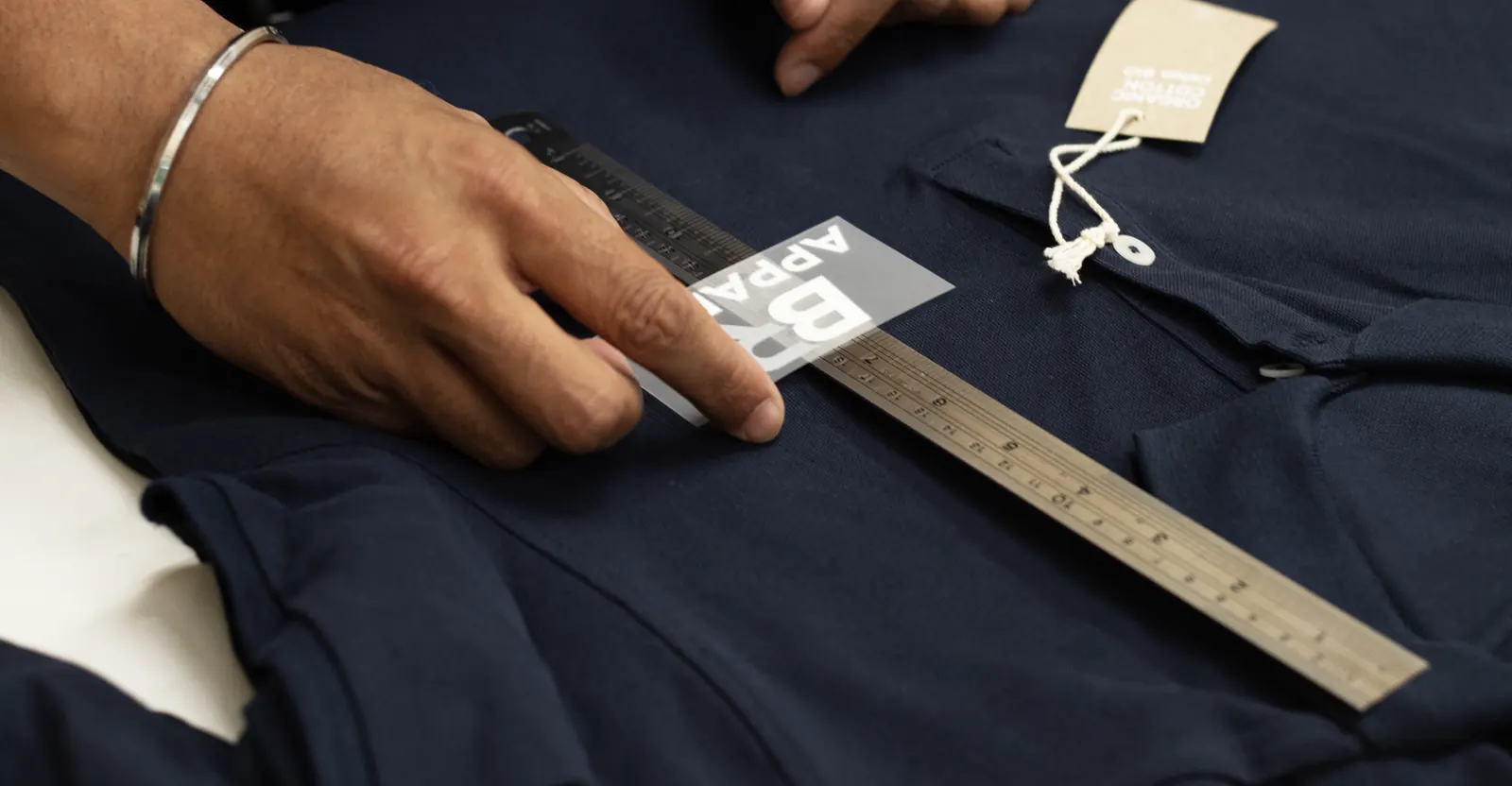
The design is printed onto film, coated with adhesive and heat-pressed onto the garment.
Best for full colour, gradients, photographic artwork and small runs. No screens, no set-up and no colour limits, so six different designs cost no more than one.
DTF is a film layer bonded to the fabric. It is thin, soft and flexible, but it sits on the surface rather than in the fibres. Correctly pressed it holds up to around 40 to 50 washes.
Embroidery
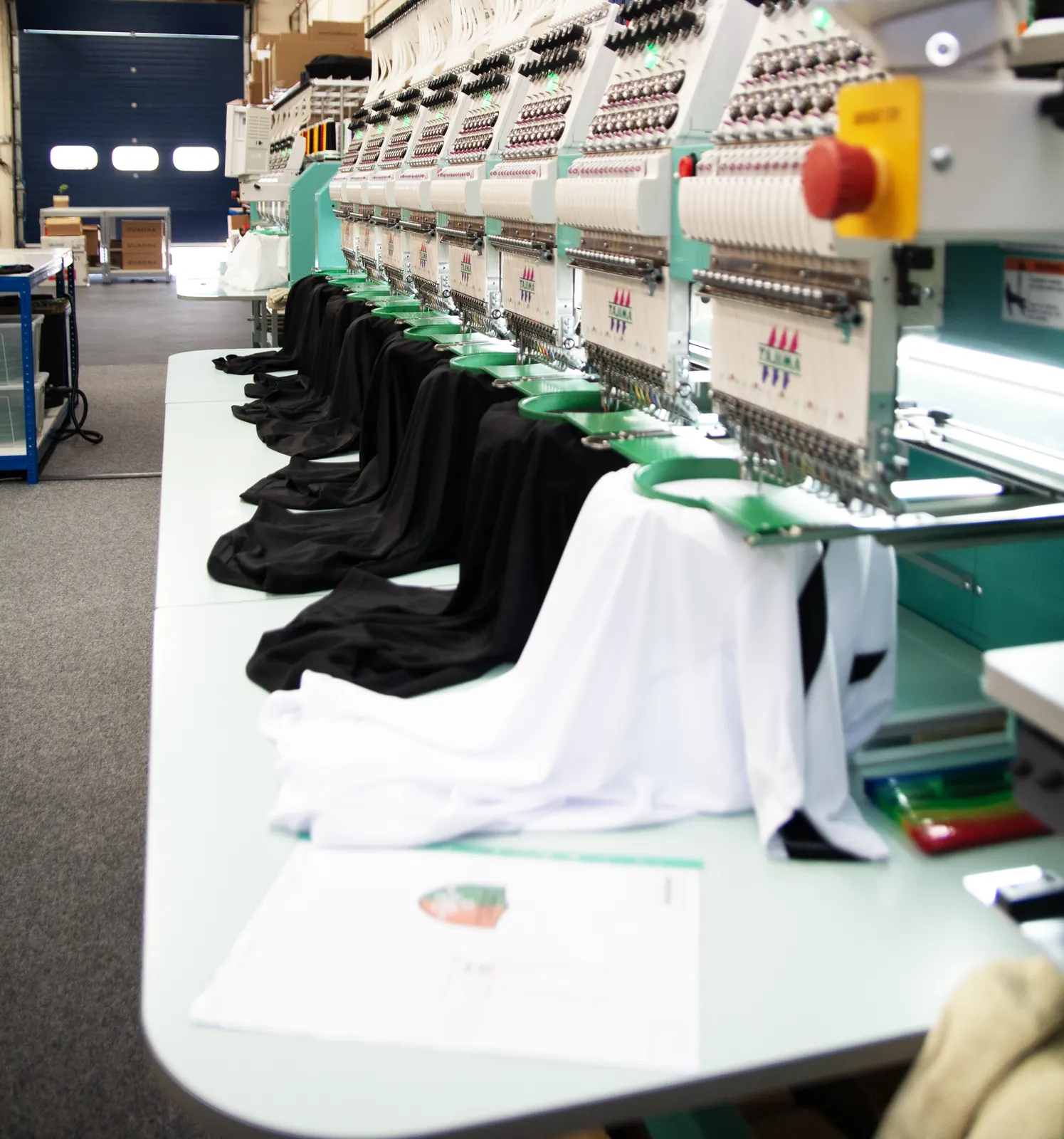
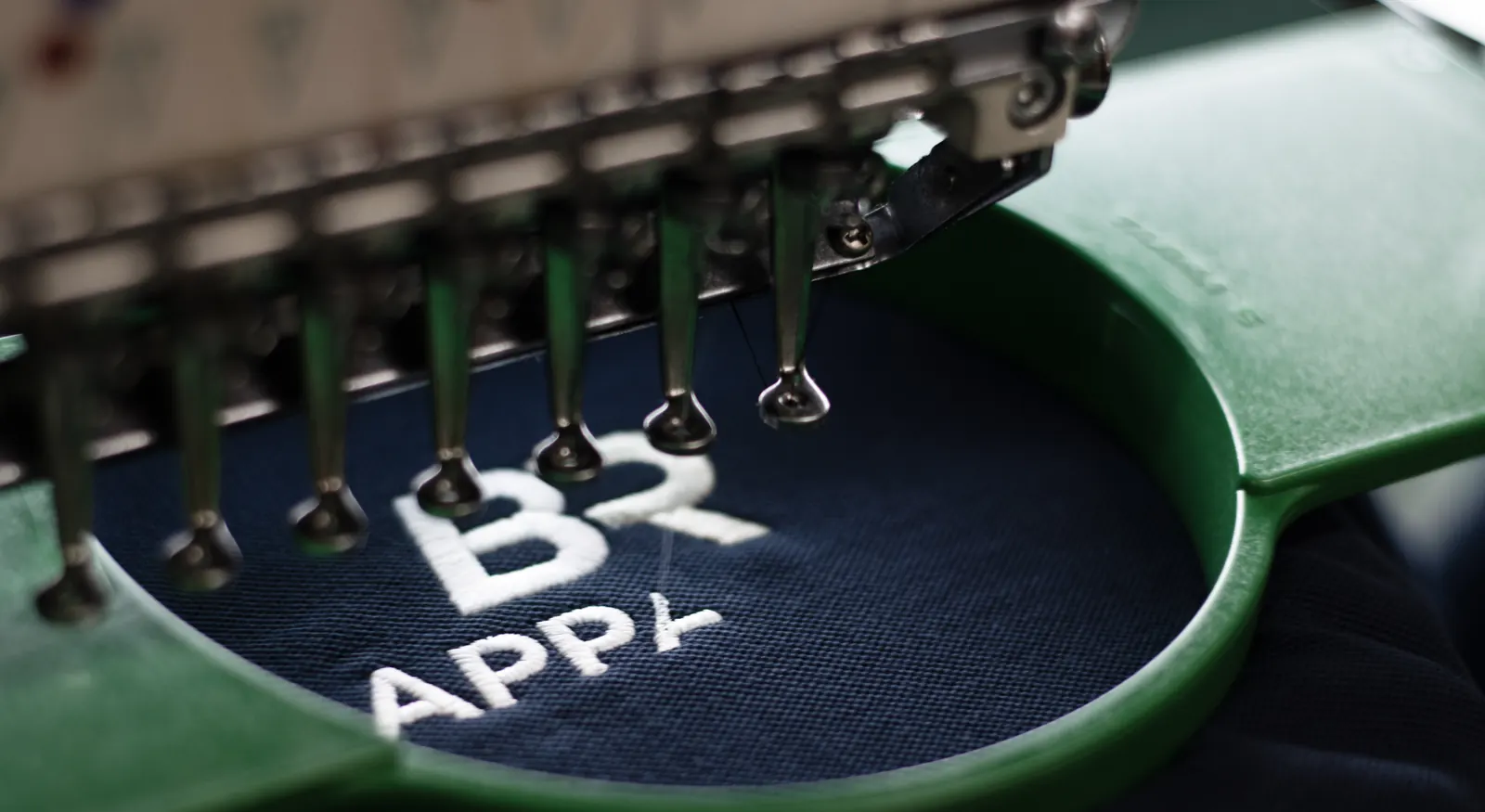
Stitched directly into the garment on Tajima machines.
Best for chest logos, caps and premium positioning. The most durable option and the one that reads as most expensive. 3D puff gives a raised, retail finish on caps.
Embroidery works differently from print. Once your design is digitised, the stitch file is fixed. The same file gives the same result every time, with no batch variation and nothing to change on a reorder. Digitising is charged once and held here, so every run after that carries no set-up at all.
There is no unit minimum on embroidery. We sample from a single garment, so you can hold the real thing before you commit to a run, which is the part overseas manufacturing cannot offer you.
A £50 minimum order value applies, because the set-up takes the same time whatever the quantity. Digitising is charged once, from £20 depending on the design, and held here for every run after that. At around 50 garments the set-up is spread far enough that the per-garment price settles, which is why most first runs land at or above that.
The thing to get right is the artwork. Embroidery has a practical floor on detail. Below roughly 40mm fine elements merge, and text under 4 to 5mm stops being readable. Designs need building for embroidery rather than shrunk down. Send us your artwork and we will tell you what will hold at size before anything is digitised.
Honest comparison
| Screen print | DTF | Embroidery | |
|---|---|---|---|
| Suits | Larger runs of the same design | Any quantity, especially small runs | Any quantity |
| Set-up | Per colour, per design | None | Digitising, per design |
| Full colour | Up to 8 spot colours | Yes | Limited |
| Feel | In the fabric | Soft film on the surface | Raised stitch |
| Durability | Can outlast the garment | 40 to 50 washes | Most durable |
| Multiple designs | Each one costs extra | No extra cost | Digitising per design |
They fail differently, which matters more than the numbers. Screen prints crack eventually. DTF fades slightly but stays flexible. Neither is simply better. It depends what you are making and who is wearing it.
How we normally run printed work
Samples, first runs and anything under 100 on DTF. No screens, no set-up, and you can test a design before committing to it.
Orders of 100 or more on screen print. There is a practical reason for the switch. DTF is a digital process and the colour can vary slightly between batches. Different machine, different film, and the shade shifts. On a first run nobody notices. On a reorder, your customer sees both garments together.
Screen print does not drift. The ink is mixed to a specified colour and your film is made once and kept at our unit, so every run comes from the same original and your second order matches your first exactly. At 100 and above the screen set-up is included, so screen print also costs less per print than DTF, and it lasts considerably longer. Below 100 a set-up applies, which is why we normally keep smaller runs on DTF.
The 100 is per design, not per garment type. Sixty tees and forty hoodies carrying the same print counts as one hundred, across as many colourways as you like, because the print itself does not change.
If you want screen print on a smaller run because you prefer the finish, we will quote it. We will just tell you honestly when DTF would cost you less for a result your customer will not be able to tell apart.
Decoration questions
- It depends on the artwork, the quantity and how the garment will be worn. Screen print suits simple designs at volume and can outlast the garment. DTF suits full colour, gradients, photographs and small runs, with no screens and no colour limits. Embroidery suits chest logos, caps and premium positioning, and it is the most durable of the three.
- There is no unit minimum. We sample from a single garment. A £50 minimum order value applies because the set-up takes the same time whatever the quantity. Digitising is charged once, from £20 depending on the design, and held here for every run after that.
- Samples, first runs and anything under 100 go on DTF: no screens, no set-up, and you can test a design before committing. At 100 or more per design, screen print is normally the better job: the ink is mixed to a specified colour, the film is made once and kept, and the second order matches the first. The 100 is per design, not per garment type.
- Up to eight spot colours. Each colour carries its own origination and its own pass through the press. Printing onto black or navy needs a base white beneath the ink, which counts as an extra colour and is included in every quote.
We have no reason to push you toward any of the three. What we will do is tell you which one suits your job, including when that is the cheaper option.
If you are not sure, send us your artwork and tell us the quantity. We will tell you which way to go and why, and which of the garments we supply takes it best.
Get my first drop quote