Launch Studio
White label vs private label: what's the difference, and which one do you actually need?
Founders ask us for private label most weeks. Almost none of them mean it.
The two terms get used as though they are interchangeable, and they are not. The difference decides your minimum order, your lead time, how much money you have tied up before you sell anything, and whether your first collection is 25 garments or 500.
Here is the honest version, including where we sit and where we stop.
What is white label clothing?
White label is taking a garment that already exists, a premium blank, and making it yours.
The supplier label comes out of the neck. Your woven label goes in. Your printed care label goes alongside it, your artwork goes on the garment, your swing ticket goes on, and the whole thing is bagged ready to sell.
The garment was designed, cut and made by someone else. Everything a customer sees as your brand is yours.
In the UK it also gets called own label, and that is the more accurate description of what it does.
The blanks come from companies that do nothing else. Stanley/Stella, Native Spirit, AS Colour, Beechfield and Yupoong for headwear. Retail weights, retail fits, proper colour ranges, and stock held so you are never waiting on a fabric run. You can see the full range on our garments page.
What is private label clothing?
Private label is cut and sew. You are commissioning a garment that does not exist yet.
Your own pattern, your fabric, your trims, your fit. It starts with a tech pack, goes through sampling rounds and fit approvals, and ends with a production run made only for you.
The upside is real. You get a garment nobody else can buy, a fit that is yours, and a pattern you own. The cost of that is not only money:
- Minimums per style, per colour. Typically 100 upward, and often several hundred once a factory is interested enough to quote properly.
- Three to four months from tech pack to delivery, longer if a fit sample comes back wrong.
- Fabric minimums on top of garment minimums.
- A deposit up front, months before anything is sellable.
- Sampling costs you pay whether the fit is right or not.
None of that is a reason to avoid private label. It is a reason to be sure before you commit.
The difference, side by side
| White label | Private label | |
|---|---|---|
| What you buy | An existing premium blank, relabelled and decorated as yours | A garment cut and sewn to your own pattern |
| Who designs the garment | The blank manufacturer | You |
| What's yours | Label, care label, swing ticket, artwork, packaging. Everything the customer sees | All of the above, plus the pattern and the fit |
| Minimum | From 25 | Usually 100+ per style, per colour |
| Lead time | Four to six weeks from artwork approval | Three to four months |
| Reorders | From stock, in the same time as the first run | A new production run |
| Money at risk before first sale | Low | High |
| Best for | Launching, testing, growing | A proven brand with a fit it cannot buy |
So which one do you need?
If you cannot yet say with confidence which of your designs will sell, you need white label. That is not a compromise. It is the correct commercial decision.
A first collection at 25 garments answers the question of what sells. A first collection at 500 asks the same question and charges you either way. The most common reason a new clothing brand stalls is not bad design. It is capital sitting in boxes in a spare room.
The founders we see doing this well launch small, find out which two styles carry the range, and reorder those. By the time they are reordering in hundreds they know exactly what they are buying.
But is it really my brand?
Yes. This is the question we get asked most, and the answer deserves more than one word.
Your name is in the neck. Your care label, your swing ticket, your artwork, your bagging. The customer never sees the blank manufacturer and has no way to know who made it. Legally and commercially it is your product, sold under your brand.
What you do not own is the pattern. Somebody else can buy the same blank and put a different name in it.
At the start that matters far less than founders expect. Customers buy the graphic, the fit they can see, and the brand. Later, when you have a following and a signature product, it starts to matter more. That is the point at which private label earns its cost, and not before.
The thing to watch when comparing suppliers
Plenty of companies advertise private label from 50 units. In most cases that is white label with the word swapped, because private label sounds more exclusive.
One question sorts it: is the garment being cut and sewn to my pattern, or bought as a blank and relabelled?
If it is the second, it is white label. There is nothing wrong with that. It is what we do and we say so. But you should know which one you are paying for, and you should not be paying a private label premium for a relabelled blank.
How to know when you have outgrown white label
Four signals, and you usually need more than one.
You are reordering the same style repeatedly
Volume on a known winner, not spread across a range you are still testing.
You want a fit that does not exist
You have handled the ranges and none of them do what you need. Not a preference, an actual gap.
You are consistently above 100 per style, per colour
Below that, cut and sew rarely works out cheaper once sampling and fabric minimums are counted.
You can afford to have money in production for four months
Without it affecting the rest of the company.
When you reach that point we will tell you, plainly. We would rather say it than watch a brand outgrow us quietly.
What we do
White label, and we are straight about it.
Premium blanks from Stanley/Stella, Native Spirit and AS Colour, plus headwear from Beechfield, Yupoong and Flexfit. Screen print, DTF and embroidery. The supplier label out and your woven label in. Printed care labels, swing tickets, size tabs, individually bagged with a size sticker.
From 25 garments. Four to six weeks from artwork approval. Reorders on approved artwork on the same lead time.
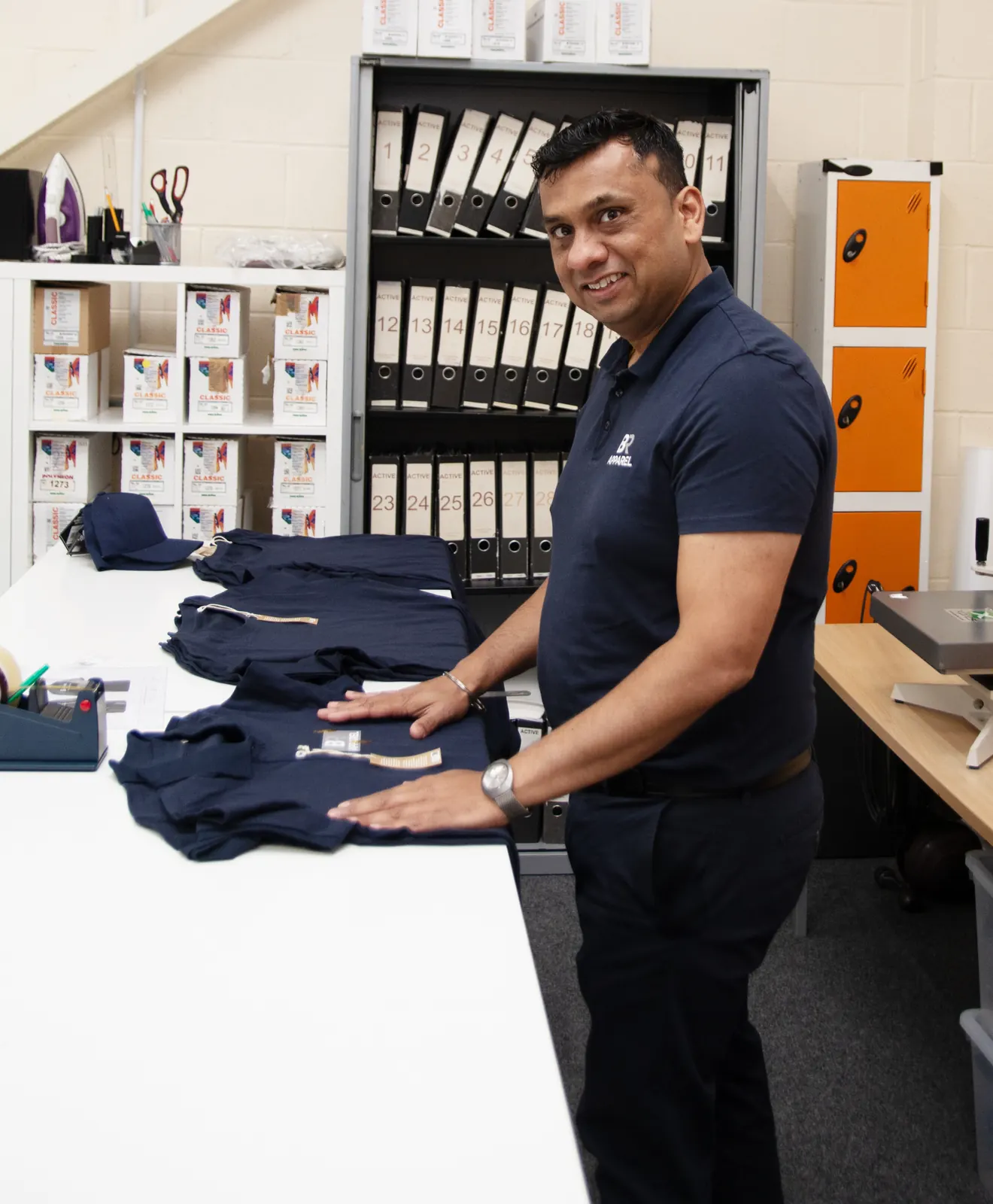
One supplier, one invoice, one point of contact, and you can come to the unit in Bradford and handle the garments before you commit to any of it.
Start with what you're making
Tell us what you are making and roughly what quantity you have in mind. We will tell you honestly which route suits it, what it takes and how long it will be, including when the answer is that you are not ready to order yet.
Get my first drop quote